

The authors describe what they call an “intelligence displacement spiral,” in which AI agents increasingly replace white-collar workers, leading to falling middle-class incomes, weaker consumption, and ultimately a broader economic collapse.

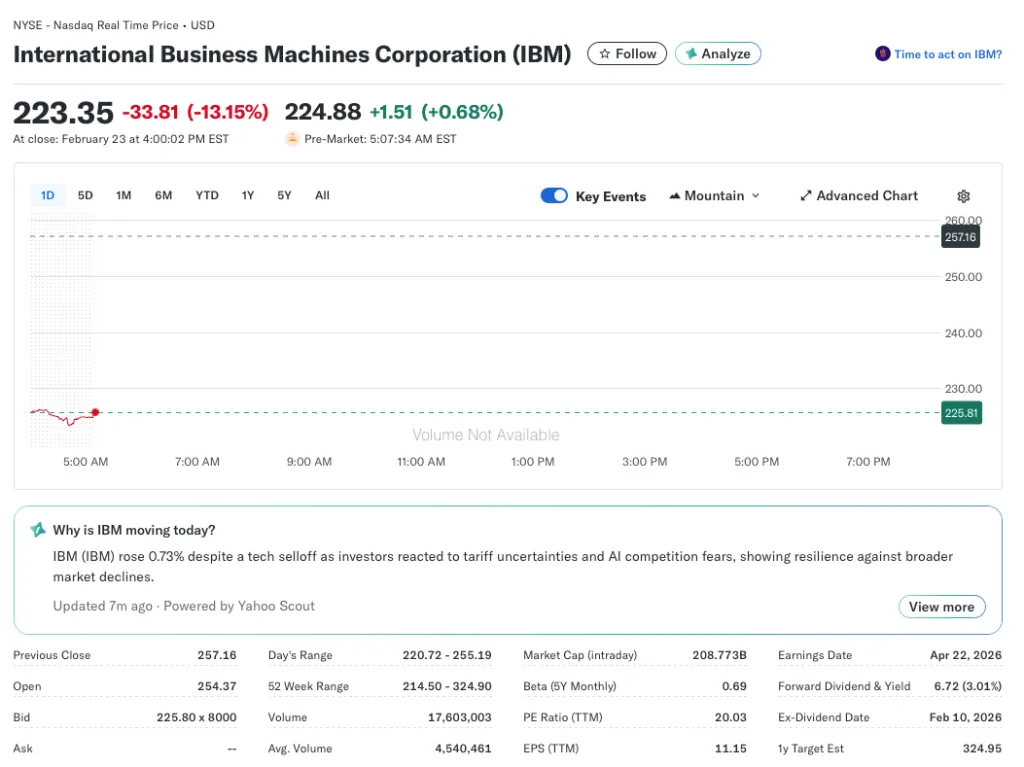
Under Citrini’s scenario, U.S. unemployment could rise to 10.2%, while the S&P 500 could fall by roughly 38%. Markets have already reacted nervously following the report’s release: the Dow Jones Industrial Average lost more than 800 points in a single day, IBM shares plunged 13%—the company’s worst decline since 2000—and stocks of American Express, Uber, Mastercard, and other major firms dropped by 4–6%.
Economists reviewing the report highlight a core issue: the U.S. economy is driven by consumption, and consumption depends on income growth. If AI boosts corporate profits while simultaneously destroying jobs and compressing wages, a gap emerges that markets cannot offset even through technological progress. Citrini refers to this as the “phantom GDP” effect—companies generate profits, but money stops circulating in the real economy.
The authors argue that new AI-related jobs will not be sufficient to offset the losses. By their estimates, “for every new AI job created, dozens disappear,” with new positions often paying less. The heaviest impact would fall on office and service-sector jobs, while manufacturing and skilled trades would be relatively less affected.
The White House has already dismissed the report as “science fiction.” The administration’s chief economist said the scenario violates basic economic principles, arguing that AI could either accelerate growth or fail to meet expectations. Other economists also point out that the authors largely ignore potential government countermeasures.
Stock sell-off
IBM shares suffered their largest single-day drop in 25 years, plunging 13.1%.
Shares of Microsoft, Oracle, and Accenture fell by 3.21%, 4.57%, and 6.58%, respectively. Payments companies Visa, Mastercard, and American Express recorded declines of 4–7%.
Market anxiety intensified amid advances at Anthropic. The company said its Claude model can optimize COBOL code, which is used primarily on IBM systems.
Citrini’s authors acknowledge that the report is not a forecast but a warning scenario. Even so, they urge policymakers to consider taxing excess profits generated by AI in order to mitigate the social consequences of automation.
 ES
ES  EN
EN