
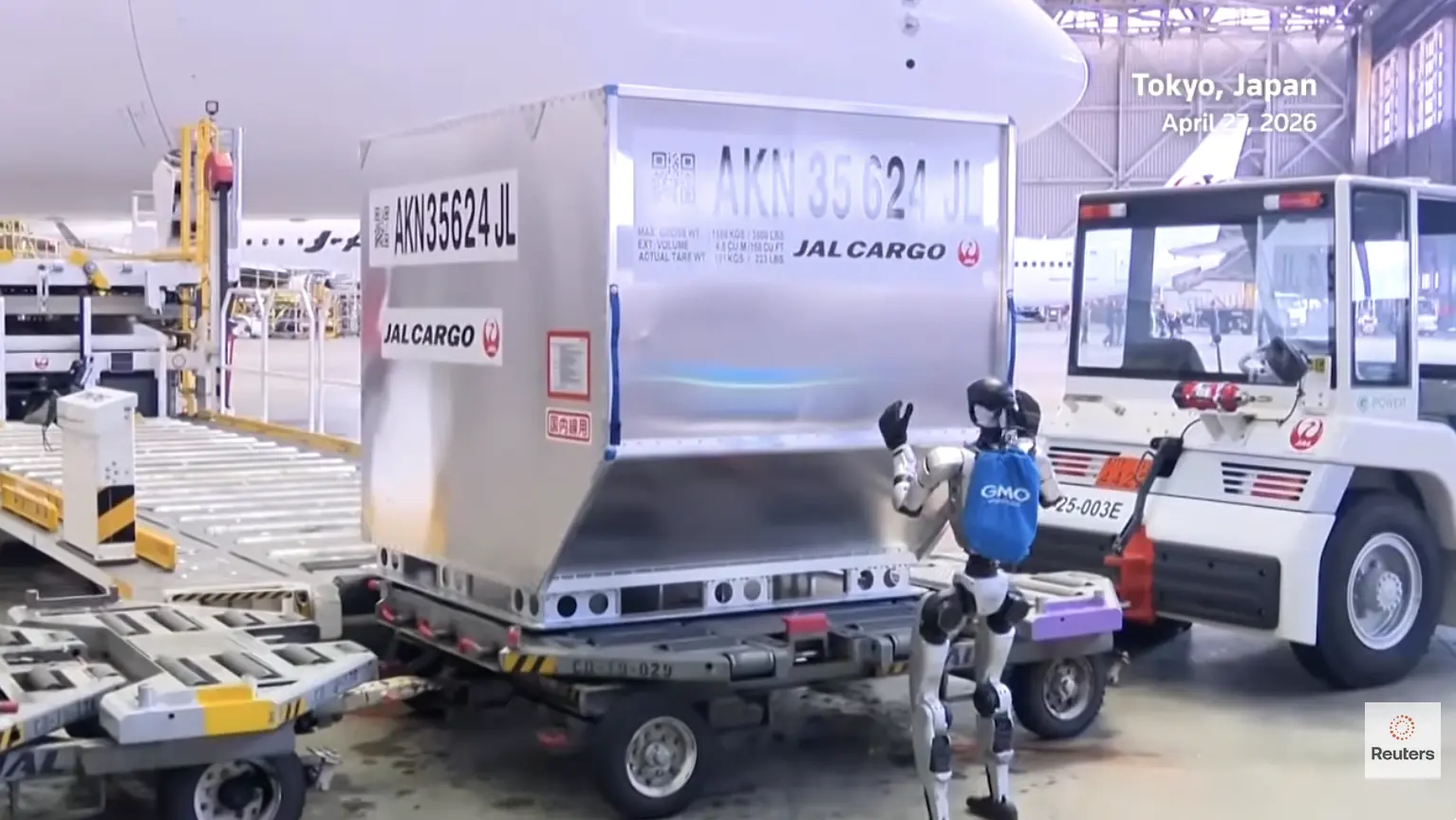
The companies have started trialing robots for baggage loading and aircraft cabin cleaning. The tests will run for two years.
The project was launched against the backdrop of rising tourist traffic to Japan and a labor shortage driven by an ageing population.
In a demonstration video, an android made by Chinese company Unitree moves cargo along a conveyor belt, waves its hand, and greets those around it.
Unitree is one of China's leading robot developers. In February, the company unveiled its flagship H1 model at a gala concert celebrating China's Spring Festival, where the robot performed kung fu moves.
It is not known whether Unitree is involved in the Haneda Airport trials.
Demographic factor
An ageing population and falling birth rates — a characteristic challenge for major cities, including Tokyo — are driving demand for humanoid robotics.
"The trends open up an opportunity for bots to perform important and often unattractive functions in manufacturing, logistics, agriculture, healthcare, and hospitality," Barclays analysts noted.
According to OECD projections, Japan's working-age population will shrink by 31% between 2023 and 2060. Counter Research Director Mark Einstein believes humanoid robots will play an increasingly prominent role in Japan's labor market.
A significant boost
In recent years, humanoid robots have significantly expanded their capabilities — largely thanks to advances in joint mechanics and artificial intelligence. They are now able to perform tasks that were out of reach just a few years ago.
Barclays considers physical robotics the "next frontier" in artificial intelligence development. The bank estimates the market could grow to $1.4 trillion by 2035, up from the current $2–3 billion.
 ES
ES  EN
EN