
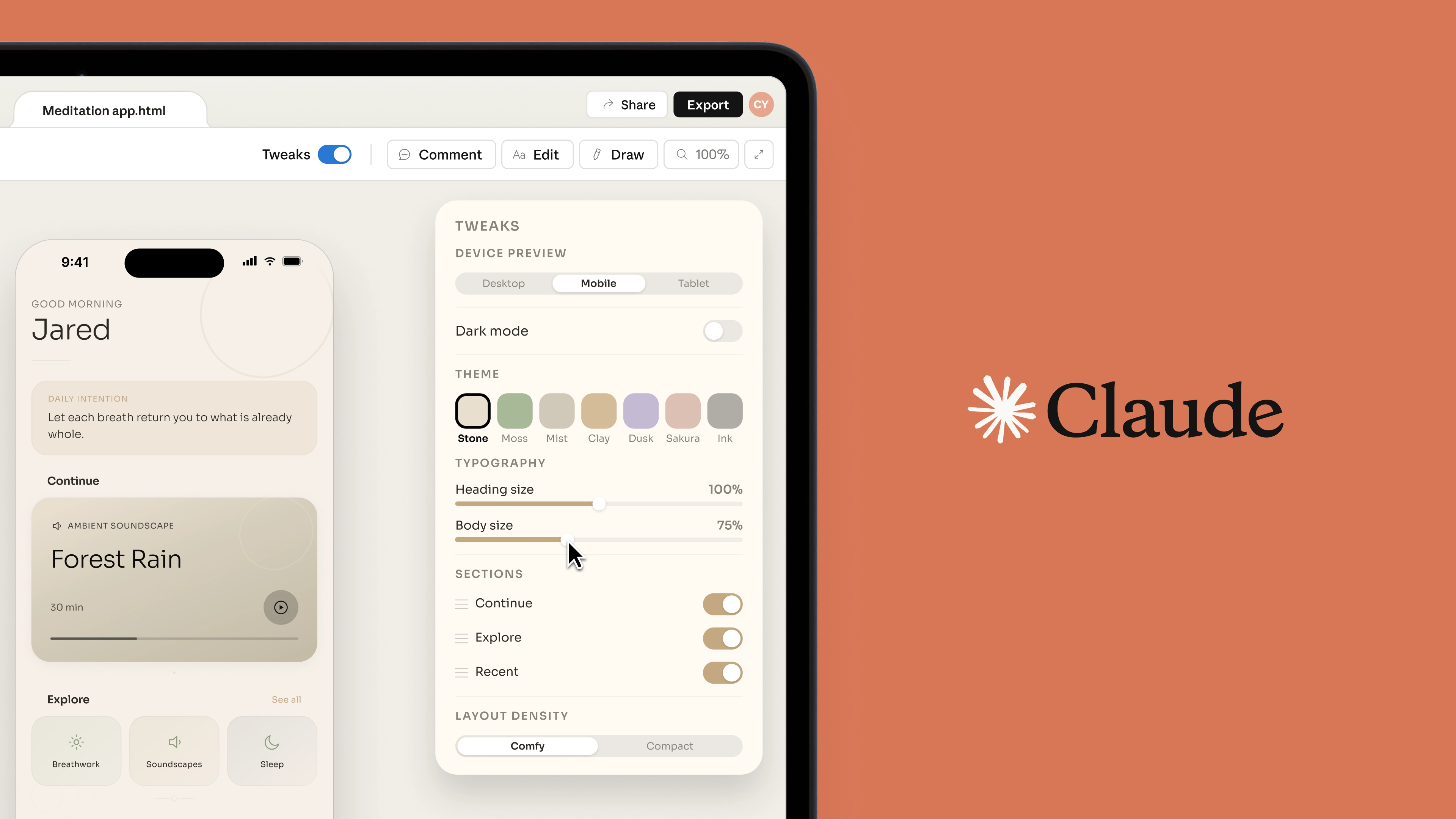
The product is part of Anthropic Labs and runs on what the company describes as its most capable vision model to date, Claude Opus 4.7.
According to Anthropic, Claude Design is available as a research preview for subscribers on the Pro, Max, Team, and Enterprise plans, with access rolling out gradually. For Enterprise customers, the feature is turned off by default and must be enabled by administrators in organizational settings.
Built for both designers and non-designers
Anthropic says Claude Design is aimed at two main audiences: designers, who often do not have time to prototype a dozen creative directions, and non-designers such as founders, product managers, and marketers who have ideas but lack a design background. The company says Claude Design is meant to “give designers room for broad exploration and give everyone else a way to produce visual work.”
The workflow follows a familiar chat-based pattern. Users describe what they need, Claude generates a first version, and that output can then be refined through conversation, inline comments, direct edits, or custom sliders. Anthropic says those sliders are generated by Claude itself and can control variables such as spacing, color, and layout.
Claude Design can also read codebases and design files, then generate a design system based on colors, typography, and components. That system can automatically be applied to new projects, and teams can maintain multiple design systems in parallel.
As input sources, Claude Design supports text prompts, uploaded images, and documents in DOCX, PPTX, and XLSX formats, as well as references to codebases. A web capture tool also allows users to pull elements directly from websites, helping prototypes more closely match the look and feel of the final product.
Use cases range from pitch decks to frontier prototypes
Anthropic says teams are already using the product to turn static mockups into interactive prototypes, sketch wireframes for product features, build pitch decks from rough outlines, and create marketing assets such as landing pages and social media graphics. Exports are available in PPTX, PDF, and HTML, or directly to Canva. Documents can also be shared internally through an organization-specific URL.
The company also highlights what it calls “frontier designs,” where users can build code-based prototypes that incorporate speech, video, shaders, 3D graphics, and embedded AI. Once a design is ready, Claude can package a handoff bundle that can be sent to Claude Code for implementation with a single command. Anthropic says integrations with additional tools will become easier in the coming weeks.
Collaboration through shared chat sessions
For collaboration, Claude Design includes organization-level sharing controls. Documents can remain private, be shared as view-only links, or be opened for editing. Team members with edit access can work with Claude together in a shared group conversation on the same document, a feature that sets Claude Design apart from more traditional design tools.
Access is included in the relevant subscription plans and counts toward standard usage limits, which can be expanded with extra usage. The entry point for the product is claude.ai/design.
Anthropic recently introduced Anthropic Labs as a new umbrella brand for experimental products, designed to test new applications beyond the traditional chat interface. Claude Design fits into that broader strategy by bringing the company’s language and vision models closer to practical workflows and placing Anthropic in more direct competition with design and presentation platforms such as Figma and Canva, as well as prototyping tools like Vercel’s v0.
Claude Design shows Anthropic moving beyond the standard chatbot interface into workflow-specific creative tools. Strategically, this puts the company into more direct competition with design and presentation platforms like Figma and Canva, while also overlapping with AI prototyping products such as Vercel’s v0
 ES
ES  EN
EN