
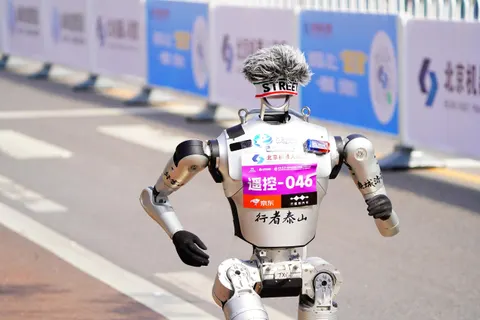
Participation also scaled up sharply. The number of teams rose from 20 to more than 100, and roughly half of the robots navigated autonomously rather than by remote control. To avoid collisions, the robots and around 12,000 human runners raced on parallel courses. Several of the top robots finished more than ten minutes ahead of the fastest human runners. Honor engineer Du Xiaodi said the winning machine had been developed over the course of a year, with 90 to 95 cm legs designed to mimic elite runners and a smartphone-derived liquid cooling system. He added that the field is still at an early stage, but that the technologies being tested could translate into improvements in structural reliability, thermal management, and industrial robotics.
At the same time, the raw finishing times do not tell the whole story. Coverage highlighting the event’s mishaps showed that a number of robots still struggled with balance, navigation, and general robustness. As with the acrobatic robot clips popular on social media, these running demonstrations do not map cleanly onto most real industrial settings, where fine motor control, perception in unstructured environments, and flexible task execution matter far more than repeated motion on a controlled course. Even so, the race does point to clear progress in hardware maturity and locomotion engineering.
The broader context is China’s effort to build a leading global position in humanoid robotics through subsidies, infrastructure projects, and public showcases. Reuters reported ahead of the race that Beijing is treating the sector as a future industrial pillar. The event also follows February’s CCTV Spring Festival Gala, where Unitree robots performed an extended martial arts routine with swords, staffs, and nunchucks alongside children — another example of China using public spectacle to signal rapid progress in robotics.
This result should not be read as proof that humanoid robots are suddenly ready for broad real-world deployment. But it does suggest that China’s leading teams are moving beyond one-off demos and making measurable gains in endurance, cooling, stability, and autonomous coordination — all of which matter for future commercial systems.
 ES
ES  EN
EN